Webinar: Emerging Merger Control Regimes

On behalf of the ICN Merger Working Group (MWG) Co-chairs, we are pleased to invite you to attend the upcoming webinar on Emerging Merger Control Regimes, taking place on 17 November 2026, from 14:00 to 15:00 CET.
The webinar will explore the practical challenges faced by emerging and developing merger control regimes, as well as the approaches adopted by competition authorities to address them.
It will bring together speakers from different jurisdictions to share their experiences and insights on the development and implementation of merger control frameworks.
Webinar details
Date: 17 November 2026
Time: 14:00–15:00 CET
Platform: Webex
Registration: Registration is required to attend. Please register here:
[https://meetagcm.webex.com/weblink/register/rf2ce9c5fd1c19687160522192091ae58]
The session will be hosted by the Saudi Arabia General Authority of competition GAC and welcomes the following participants:
Dr. Willard Mwemba is the Chief Executive officer, COMESA Competition and Consumer Commission.
Rawan Shaarawy is the Head of Mergers Team at the Economic Concentrations Department, Egyptian Competition Authority (ECA).
Mariami Berulava is the Deputy Head of Strategic Market Monitoring Department, Georgian Competitor and Consumer Agency .
Étienne Chantrel is a NGA for the New Caledonia Competition Authority (Autorité de la concurrence de Nouvelle Calédonie or ACNC).
Charles H.K. Chen is an inspector of Taiwan Fair Trade Commission(TFTC).
We look forward to your participation and to an engaging discussion.


ICN Work Plans 2026-2027
ICN Steering Group Approves 2026–2027 Work Plans
9 September 2026
The ICN Steering Group has approved the Work Plans for the 2026–2027 cycle. These plans will guide the work of the network over the coming year and reflect the ICN continued focus on promoting convergence, sharing best practices, and strengthening international cooperation in competition law and policy.
The Work Plans will be officially presented during the ICN 2026–2027 Kick-Off Call, scheduled for 17 September 2026. The call will bring together ICN members and NGAs to review key priorities, planned outputs, and opportunities for engagement across all areas of the network’s work.
Full details of the 2026–2027 Work Plans are provided below.
The ICN welcomes the active participation of its members and NGAs in the implementation of these plans and looks forward to a dynamic and collaborative ICN year ahead.
Contact:
ICN Chair Office (ICN[email protected]) & Secretariat (icn[email protected])

2026 ICN-WBG Competition Advocacy Contest
The International Competition Network and the World Bank Group are pleased to announce the launch of the 2026 Competition Advocacy Contest, which follows the successful experience of the previous eleven joint editions.
We are looking for success stories from competition agencies, other government bodies or non-governmental organizations that demonstrate the tangible results of competition advocacy regarding:
Theme 1 – Advancing competition advocacy in times of rapid changes in the global landscape
Theme 2 – Promoting a culture of compliance through innovative advocacy and digital tools
Theme 3 – Embedding competition principles in the green and digital transitions
Theme 4 – Global convergence vs. country specificity: contextualizing competition law and policy
The deadline for submissions is January 23, 2026.
For more information and details on how to apply please visit the following web-page:
https://www.worldbank.org/en/events/2025/12/05/competition-advocacy-contest-2026
We welcome your participation!
Competitiveness Unit, World Bank Group, and the Italian Competition Authority on behalf of the ICN Advocacy Working Group Co-Chairs

ICN Work Plans 2025–2026
ICN Steering Group Approves 2025–2026 Work Plans
16 September 2025
The ICN Steering Group has approved the Work Plans for the 2025–2026 cycle. These plans will guide the work of the network over the coming year and reflect the ICN continued focus on promoting convergence, sharing best practices, and strengthening international cooperation in competition law and policy.
The Work Plans will be officially presented during the ICN 2025–2026 Kick-Off Call, scheduled for 17 September 2025. The call will bring together ICN members and NGAs to review key priorities, planned outputs, and opportunities for engagement across all areas of the network’s work.
Full details of the 2025–2026 Work Plans are provided below.
The ICN welcomes the active participation of its members and NGAs in the implementation of these plans and looks forward to a dynamic and collaborative year ahead.
Contact:
ICN Chair Office (ICN[email protected]) & Secretariat (icn[email protected])

Andreas Mundt, Bundeskartellamt, Germany, hands over chair to Andrea Marván, Competition Authority Mexico
The 24th Annual Conference of the International Competition Network (ICN) was hosted by the UK CMA in Edinburgh, Scotland, from 7 to 9 May 2025. Participants from more than 90 jurisdictions attended this year’s conference, including representatives and stakeholders from the business community, legal and economic professionals, international organisations and academics.
The ICN is the most important network of competition authorities worldwide and a unique forum for the authorities to come together, exchange ideas and find joint solutions. It comprises more than 140 competition agencies.
At the conference, participants shared experiences and engaged in discussions in the plenaries and breakout sessions organised by the ICN working groups. Special sessions were dedicated to the role of competition in driving productivity, innovation and growth, and to a global update on competition in digital markets. Keynote speeches and interviews were given by the UK’s Minister for Employment Rights, Competition and Markets, Justin Madders MP, Chairman of the US FTC, Andrew Ferguson, Executive Vice-President of the European Commission, Teresa Ribera, and Assistant Attorney General for the Antitrust Division of the US DOJ, Gail Slater, among others. The conference recordings are available here.
At the conference, Andreas Mundt, President of the Bundeskartellamt, handed over the chair of the ICN Steering Group to Andrea Marván, President of the Mexican competition authority. Andreas Mundt was involved in the creation of the ICN, has been Chair since 2013 and hosted the ICN Annual Conference in Bonn in 2005 and in Berlin in 2022. He will continue to serve as a member of the ICN Steering Group.

Andreas Mundt, President of the Bundeskartellamt and former ICN Chair
“It has been a true pleasure and an even greater privilege to be at the helm of the ICN for so many years, which have not always been smooth sailing. The ICN is a stable, mature, influential and widely respected international organisation that has grown not only in membership but also in the range of issues it covers. Its strength lies in the direct connection between its members and its focus on issues that truly matter to them.”

Andrea Marván, President of the Competition Authority Mexico and new ICN Chair
“My goal to serve as Chair of the Steering Group stems from a profound sense of duty and dedication to the network beyond the honor associated with this position, and a desire to fully harness the network’s potential through the contributions from its members.”
2025 ICN Annual Conference in Edinburgh, United Kingdom

The 24th Annual Conference of the International Competition Network (ICN) will be hosted by the UK Competition and Markets Authority (CMA) in Edinburgh, United Kingdom from 7 to 9 May 2025.
The annual conference brings together agencies to have an open dialogue and share ideas and best practices. This benefits all agencies, ensuring consistency and efficiency in competition enforcement in the interest of promoting competition on behalf of consumers and fair-dealing businesses.
For further information on the ICN Annual Conference, please visit the conference website. The plenary sessions will be livestreamed.
ICN Work Products 2025

The ICN 2024/25 work products to be presented to the ICN membership at the ICN Annual Conference in Edinburgh are now online:
ICN Statement of Achievements 2025-2026
The ICN Statement of Achievement 2025-2026 is available here.
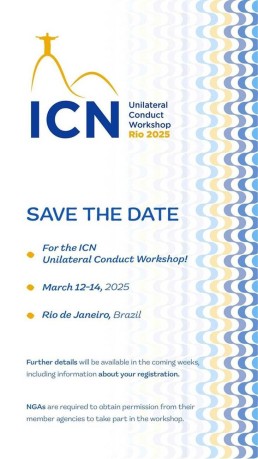
ICN Unilateral Conduct Workshop 2025
Registration is now open on the workshop website and the full agenda is available here.
Should you have any questions regarding the event, please contact [email protected]
2025 ICN-WBG Competition Advocacy Contest
The International Competition Network and the World Bank Group are pleased to announce the launch of the 2025 Competition Advocacy Contest, which follows the successful experience of the previous ten joint editions.
We are looking for success stories from competition agencies, other government bodies or non-governmental organizations that demonstrate the tangible results of competition advocacy regarding:
Theme 1 – Supporting resilient and competitive value chains to enable private investment, jobs, and consumer welfare
Theme 2 – Embedding competition principles in policies to manage state assets: SOEs, privatization and public private partnerships
Theme 3 – Enhancing public procurement and curbing bid rigging for government savings
Theme 4 – Advancing competition through public-private dialogue
The deadline for submissions is February 14, 2025.
For more information and details on how to apply please visit the following web-page:
https://www.worldbank.org/en/events/2024/12/06/competition-advocacy-contest-2025
We welcome your participation!
Competitiveness Unit, World Bank Group, and the Italian Competition Authority on behalf of the ICN Advocacy Working Group Co-Chairs